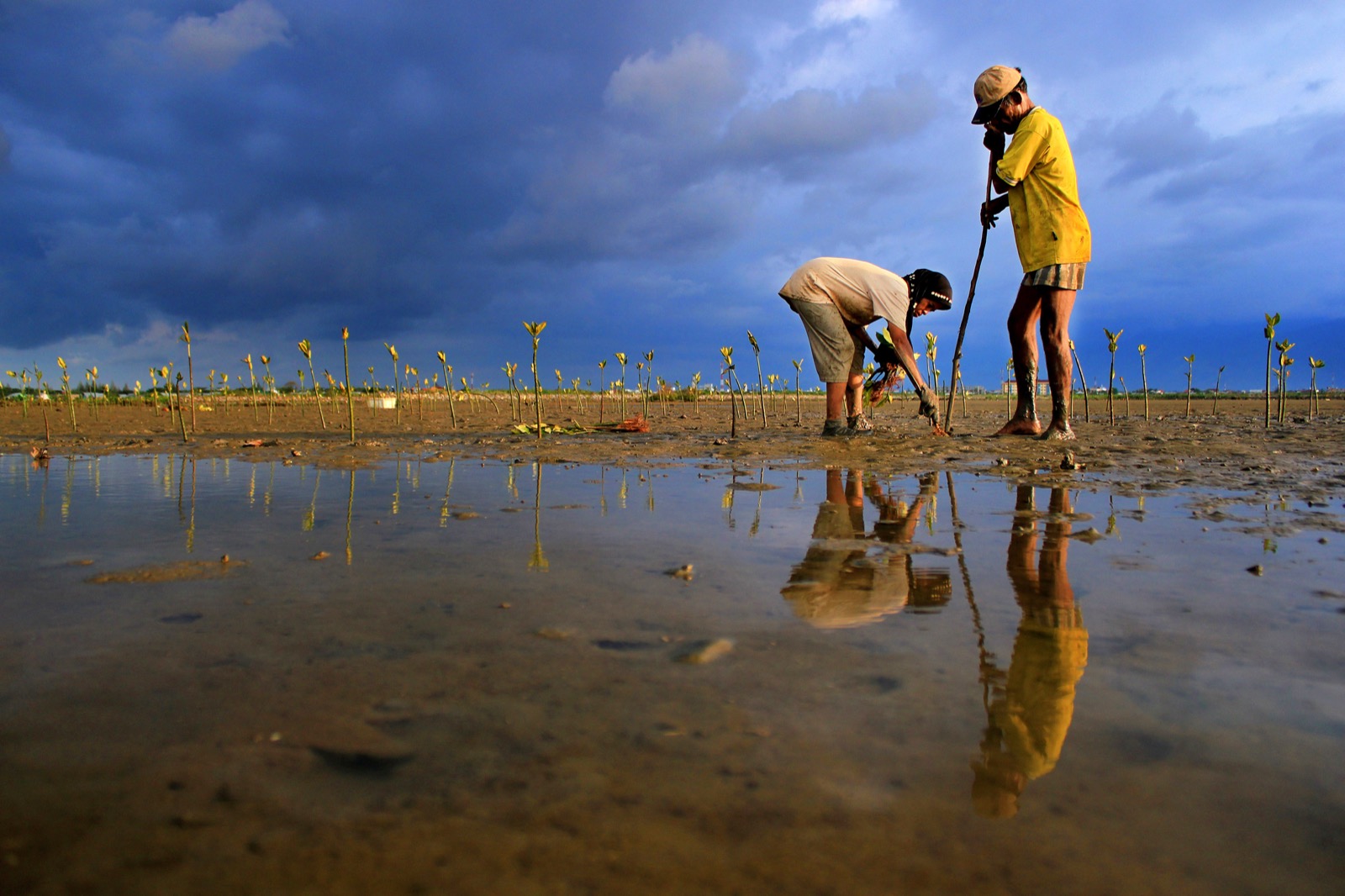
Indonesia's carbon governance sits on a Presidential Regulation lineage rather than a single statute. Presidential Regulation No. 98 of 2021, Indonesia's first economy-wide carbon-pricing framework, was repealed in 2025 and replaced by Presidential Regulation No. 110 of 2025, which recognises voluntary-carbon-market activity, splits internationally transferable Article 6 units from domestic-only ones, and centralises registry duties in one system (SRUK). Indonesia's newest NDC, submitted on 27 October 2025 and labelled "NDC3.0" by climate-laws.org though Indonesia's own cover materials call it a "Second NDC," sets a 2030 emissions peak with decline to 1.26 to 1.49 GtCO2e by 2035, and reaffirms net zero by 2060 or sooner, resting on the Long-Term Strategy for Low Carbon and Climate Resilience 2050, filed with the UNFCCC in 2021. As of the most recent press coverage checked, in December 2024, Indonesia's draft Government Regulation on the Protection and Management of Mangrove Ecosystems remained unenacted, awaiting presidential signature.
Projects
Bundled Landfill Gas Recovery Project in Indonesia
A single CDM registration bundling three landfill gas sites in Kalimantan, Lombok and Sulawesi.
Eden: People+Planet
Hiring local people to restore mangroves and forests across the Global South, one village at a time.
Indonesian Domestic Biogas Programme (BIRU)
Hivos and SNV's domestic biogas programme building a commercial biodigester market.
Katingan Mentaya
One of the world's largest intact tropical peat swamp forests, kept wet to lock carbon underground.
Mangroves for Coastal Resilience (M4CR)
A USD 400 million, results-based World Bank effort to restore Indonesia's vast mangrove estate.
Piyungan Landfill Gas Capture Project
A large-scale CDM landfill gas project at Yogyakarta's Piyungan landfill, run by Japan's Shimizu Corporation with Indonesian technical agencies.
Prime Cookstoves (Clean Stoves Initiative Indonesia / Low Emissions Enterprise)
Kopernik's Prime cookstoves cut wood use by half for over 10,000 users in Indonesia.
Riau Ecosystem Restoration (RER)
One of Southeast Asia's largest private-funded peat-swamp restoration programmes
Rimba Raya Biodiversity Reserve
A pioneering peat-swamp reserve buffering Tanjung Puting, now at the centre of a licensing dispute.
Sarulla Geothermal Power Generation Project
A 320 MW geothermal power project developed across three units in North Sumatra.
Yagasu Mangrove Restoration
One of the earliest and largest blue carbon restorations, with 30 million mangroves planted across Sumatra's degraded coast.
Yagasu-Apolownia Mangrove Carbon Project
A 3,300-hectare mangrove carbon project awaiting Verra listing.
Yagasu-VNV Mangrove Carbon Project
An 8,000-hectare mangrove carbon project validated by the Gold Standard.
Regulation
Framework law
"Peraturan Presiden Republik Indonesia No 98 Tahun 2021 tentang Penyelenggaraan Nilai Ekonomi Karbon untuk Pencapaian Target Kontribusi yang Ditetapkan Secara Nasional dan Pengendalian Emisi Gas Rumah Kaca Dalam Pembangunan Nasional"title/metadata page (jdih.kemenkoinfra.go.id)
Established Indonesia's first economy-wide carbon pricing framework (trading, results-based payments, levies) across energy, waste, IPPU, agriculture, forestry sectors, tied to NDC achievement.
Issuing body: Kementerian Sekretariat Negara — State Secretariat · Corroborated
NDC
"JAKARTA (October 30, 2025) – Ahead of COP30, Indonesia has recently submitted its new nationally determined contribution (NDC), projecting that emissions will peak by 2030 and then decline to 1.26 and 1.49 gigatonnes of carbon dioxide equivalent (GtCO₂e) by 2035 under two economic growth scenarios."WRI Indonesia statement, dateline paragraph
Sets Indonesia's post-2030 emissions pathway (peak 2030, decline to 1.26–1.49 GtCO2e by 2035 across two growth scenarios); reaffirms Net Zero by 2060 or sooner.
Issuing body: KLHK, lead ministry · Corroborated
Carbon market
"This Presidential Regulation introduces several important changes that reshape Indonesia's carbon governance framework. It replaces Presidential Regulation No. 98 of 2021 on Carbon Economic Value... The key elements are: 1. The recognition of Voluntary Carbon Market (VCM) activities; 2. The acknowledgement of established international standards, and abolition of the earlier Mutual Recognition Agreement (MRA) mechanism; 3. Carbon projects may choose to obtain certification either from the Indonesian government (Sertifikat Pengurangan Emisi – SPE) or from other recognized certification bodies (non-SPE); 4. Differentiation between Corresponding Adjustment (CA) units under Article 6... and non-CA units...; 5. A centralised registry (Sistem Registri Unit Karbon; SRUK)..."climate-laws.org family summary field
Replaces PR 98/2021; recognises VCM activity, splits internationally-transferable Article 6 (CA) units from domestic-only units, creates one centralised registry (SRUK), keeps prior implementing regs alive where non-contradictory.
Issuing body: Presidency of the Republic of Indonesia · Single source
Forest / REDD+
"The drafting of a government regulation concerning mangroves is expected to fortify the protection of mangroves while enhancing the community's capacity ..."article meta-description, ANTARA News, dated 2024-12-17
Still a draft PP as of the last checked press coverage (Dec 2024), reportedly awaiting presidential signature; would create an integrated cross-sector/cross-region mangrove management and enforcement framework.
Issuing body: Ministry of Environment and Forestry (Indonesia) · Single source
Net-zero / LTS
"Long-Term Strategy for Low Carbon and Climate Resilience 2050 (Indonesia LTS-LCCR 2050)... covers adaptation and climate resilience alongside emissions reduction... renewable energy deployment, and just transition principles."climate-laws.org document summary field
Indonesia's UNFCCC-filed long-term strategy to 2050, underpinning both NDC3.0 and the Net Zero by 2060 target.
Issuing body: government-body:indonesian-ministry-of-environment-and-forestry · Single source